amberstack/

AI workflows your team will actually ship.

n8n + Claude Code, EU-hosted infrastructure, 30-day fit-check exit on every build.

{{ TODO: copy }} - client logos OR one-sentence testimonial

01 / workflows

Workflows, shipped end-to-end

Inbound qualification → CRM

Stripe-style intake form posts to n8n. Claude classifies, scores, and drafts a reply. Hubspot deal created with full context.

Support triage with private context

Inbox webhook → embeddings over your docs + past tickets → Claude writes a draft reply, agent approves in one click.

live

Lead enrichment from a single domain

Domain in, structured firmographics out: ICP fit, tech stack, hiring signals, latest news, contact suggestions.
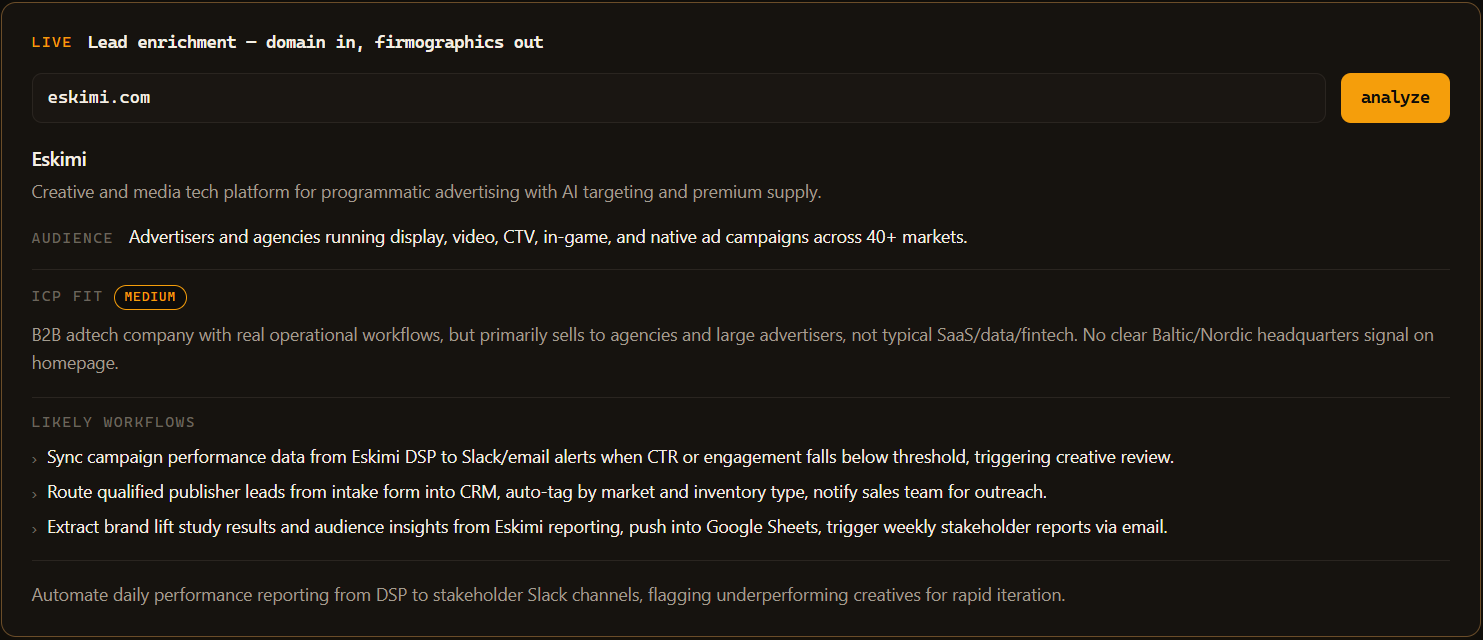
Lead enrichment demo output rendered on the site

try the demo ›

Weekly revenue digest

Pulls Stripe, Hubspot, Postgres. Claude writes a 6-line summary with anomalies flagged. Posted to Slack Monday 09:00.

Churn-risk alerts

Usage + support sentiment + invoice lag → risk score. Anything above threshold lands in CS lead's queue with reasoning.

RFP / security questionnaire autofill

Upload PDF/DOCX. Workflow extracts questions, retrieves your prior answers, drafts new ones, exports back to original format.

02 / case study

From zero posts to daily drafts on a Shopify store

In-house pilot, Lithuanian e-commerce brand

Posts/week ~0 → 2-3Time per post: hours of blank-page → up to 15 min of proof and polish.

Problem

One-person store. Social was supposed to drive traffic but wasn't happening. The slow part wasn't typing, it was deciding what to post and which product to tie it to before writing started.

Solution

Daily n8n run pulls Lithuanian calendar context (date, name day, holiday, season, weather), fetches in-stock Shopify products, asks Claude for 2-3 drafts per day. Some tied to the calendar, some to a specific product. Tracking links built at draft time.

Build time
~25 engineer-hours
Stack
n8n · Claude · Shopify
Read the full case study

03 / about

Who you're hiring

Erikas. Vilnius. AI Enablement Lead at a Lithuanian data infra company by day. Joined writing Python, ended up running a team of engineers. Got a US patent along the way. The thing that keeps me in this work: most office tasks are wasteful and nobody questions it because that's how it's always been done. Status reports rewritten when last week's would do. Same data copy-pasted across three tools. Automate the boring parts and people get their afternoons back for work that actually needs thinking.

LinkedIn

04 / how it works

Three ways to start

  1. 01

    Audit

    Map your highest-leverage automations. Walk away with a prioritized backlog.

  2. 02

    Build

    Pick a workflow from the audit. I ship it to production in 2–4 weeks.

  3. 03

    Retainer

    Ongoing maintenance, tuning, and new builds. Month-to-month after a 90-day initial term.

05 / pricing

Engagement tiers

Audit

€3,500/ 10 working days

Map your highest-leverage automations. Walk away with a prioritized backlog.

  • Stack + data audit
  • Top 5 workflows scored by ROI
  • Build estimates per workflow
  • 60-min walkthrough call
see a sample deliverable ›

Build

from €11,000fixed scope

Pick a workflow from the audit. I ship it to production in 2–4 weeks.

  • Fixed scope, fixed price
  • Production deploy on your infra
  • Monitoring + rollback included
  • Loom handover + README
  • 30-day fit-check exit on the first month
most common

Operations Tier

from €2,200/ month

Ongoing maintenance, tuning, and new builds. Month-to-month after a 90-day initial term.

  • 2 workflows under maintenance
  • ≤30h of new build per quarter
  • Biweekly office hour
  • Next-business-day SLA, 4h on critical incidents

Operations Tier - Plus

€3,500/ month

Deeper engagement when 2 workflows aren't enough.

  • 4 workflows under maintenance
  • ≤50h of new build per quarter
  • Weekly office hour
  • 4h response SLA, business hours

06 / stack

Boring, EU-hosted, all yours

Workflow engine
n8n, self-hosted on a VM you own. Pinned versions, no per-seat tax. Workflow definitions live in your git org.
LLM providers
Anthropic, OpenAI, Mistral, OpenRouter as fallback. EU endpoints where offered. Model choice is per-workflow - swap in minutes.
Glue code
Python by default. TypeScript when the integration is JS-native.
Storage & state
Postgres 16 alongside n8n. State, logs, pgvector embeddings. Supabase EU if you'd rather not self-host.
Observability
Every LLM call and workflow run traced through Langfuse - inputs, outputs, tokens, latency, failures. Source for the monthly report.
Infra
Hetzner (Falkenstein or Helsinki), Caddy + auto Let's Encrypt, UFW + Cloud Firewall, nightly encrypted Postgres backups to Object Storage. nginx on request.

Hetzner and LLM providers bill you directly - VM €10–20/mo typical, model spend on your own API keys. Both separate from the retainer. Tracing runs on our side: monthly Langfuse report on call volume, tokens, latency, failures and fixes. Not another login.

07 / faq

Questions worth asking up front

How is pricing structured?
Four tiers. Audit Sprint: €3,500, 10 working days, fixed scope. Build: from €11,000, fixed scope, fixed deadline; multi-workflow or LLM-heavy builds quoted up to €16,000. Operations Tier: from €2,200/month, 90-day initial term then month-to-month. Operations Tier - Plus: €3,500/month for teams that need 4 workflows under maintenance and weekly cadence.
Who owns the IP?
You do. All workflows, code, prompts, and infrastructure are yours from day one. Repo lives in your GitHub org. No vendor lock-in clauses, ever.
Where does the data live?
EU-resident by default. Hetzner Nuremberg or Helsinki, Supabase EU regions, Anthropic EU endpoint where available. DPA on request. No data leaves the EU without your explicit approval.
What does the refund policy look like?
Build: 30-day fit-check exit. If, during the first 30 days of the build, either side determines it's not a fit (scope drift, surprise integration, cadence mismatch), you exit. Build fee refunded minus hours already worked at a published time-and-materials rate. Audit: refundable for the first 3 working days, no questions. Retainer: month-to-month after a 90-day initial term - no penalty to stop after that.
What do I own after the engagement?
Source for every workflow, deployment scripts, n8n instance, database, secrets. A README explaining how each piece works. A Loom walkthrough for non-engineers on your team.
What happens if a workflow breaks at 3am?
Operations Tier: next-business-day SLA on non-critical issues, 4h on critical incidents - all during EU business hours. Operations Tier - Plus: 4h SLA on everything during EU business hours. Outside hours on both tiers, alerts route to your team. Every workflow ships with health checks and a documented rollback procedure.
What does onboarding look like?
Audit: read-only access on day 1, scored backlog and Notion doc shipped on day 10. Build: kickoff within 7 working days of signature, working prototype by day 5, production deploy in 2–4 weeks. You'll have artifacts in your hands fast either way.
What's in scope for the retainer?
Operations Tier: 2 workflows under maintenance, ≤30h of new build per quarter, monitoring, prompt tuning, model upgrades, biweekly office hour. Operations Tier - Plus adds 2 more workflows under maintenance, ≤50h quarterly build, and a weekly office hour. Out of scope on both: full-team training, building a separate product, anything that would need a second engineer.
How do you keep an eye on workflows after they ship?
Every LLM call is traced on amberstack's observability stack. You get a monthly report - call volume, token spend, latency, failures and fixes. No dashboard for you to babysit.

08 / contact

Book a 30-minute audit call

Pick a slot below or email hello@amberstack.eu. Calls are 30 minutes, no slide deck, screen-share recommended so I can poke at your stack live.